Come up with your own game
The warm-up is over. Choose the game you want to take through to release, with your own genre, setting and tone. Start from scratch or keep an idea you tried in the first three days. The agent will help record your decisions and build a first draft.
sketch.html: a one-screen draft with the main action, obstacle, win and lossGAME.md: eight decisions, two rules and the size of your game- your own folder
~/games/my-gameand version day-04 - To try it: ask to open
sketch.htmland play a round
Dino, Bird and Snake have done their job. You can leave them in first-game and never return to them. Your main project lives separately in my-game. The lesson examples are suggestions; your game doesn’t need their characters, setting or rules. We keep the scope small so you can finish. The tone and subject are yours to choose.
If you already have an idea, check the genre and art method in step 2, then create your game folder. Try the exercises in steps 3 and 6 as well: they help pin down the idea.
Came via the quick start?
You can skip step 1, which uses the remix from days 2–3. Create your notes in step 4 and skip the remix settings in step 8. The working habits we use later are in the quick start.
One more round in yesterday's game
Open your remix, press P and play for a minute. Remember which settings you chose and why.
A quick recap
The hero left the edge a moment before you pressed jump. Which setting could help?
- Increase the jump heightThe jump never started because the press came after the edge. Height will not fix that.
- Add about 0.1 s of coyote timeYes. It gives you a short window to jump after leaving the edge.
- Shrink the hitboxThat affects collisions. Here, the jump input arrived too late.
You adjusted two sliders and the jump improved. What is still unclear?
- Whether the panel allows two changesIt does. But the test does not tell you what each number contributed.
- Which number helpedRight. Put one back to its old value and compare.
- How to get the old settings backReloading restores the CONFIG values, but it does not tell you which change helped.
By tonight
Yellow marks your decisions; green marks the agent's work. First, choose the game you want to make.
Choose a genre
Your genre and art method determine the examples and homework you will see. If you picked them earlier, check your choices and carry on.
How your game will look
no extra cost
Model to match
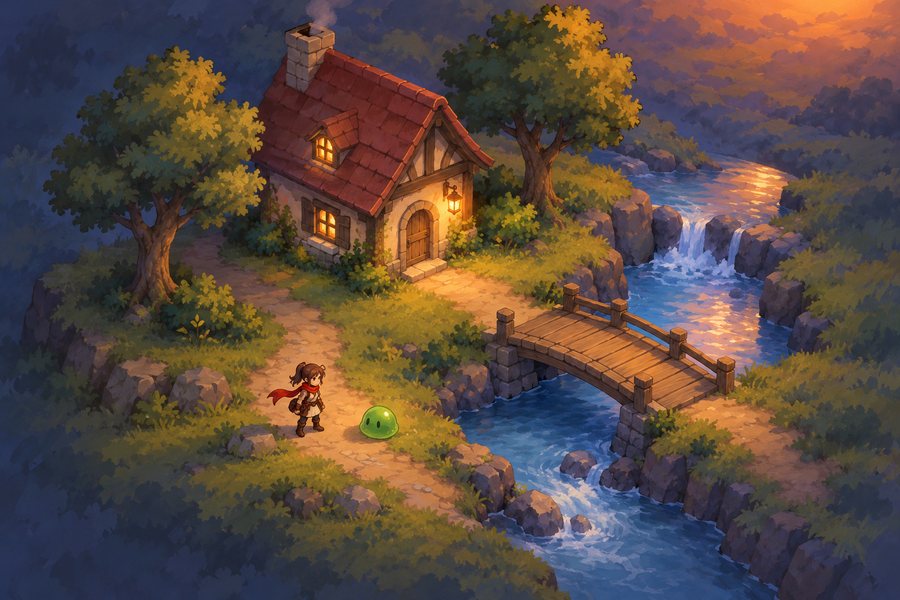 target picture
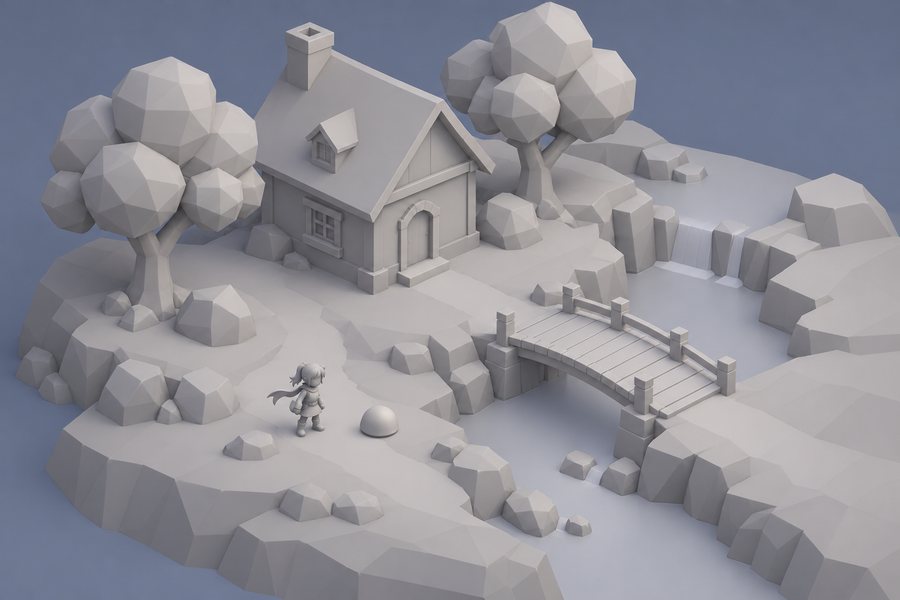 3D models in Blender
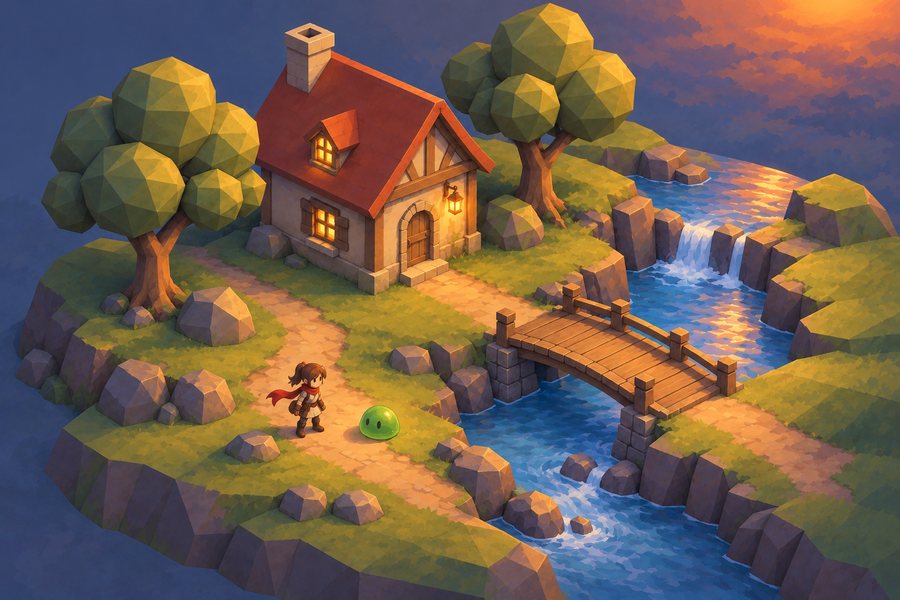 frame with a filter
- what you get
- A world matching the picture you pick on day 7: cartoon, pixel, painterly or low-poly.
- how it works
- The agent builds a 3D world; a style filter makes it look drawn, and camera and light match your picture. Like the fighting game Guilty Gear Xrd: 3D inside, drawn on screen.
- what you need
- Free Blender: you install it on day 8, the agent uses it.
- cost
- No extra cost for art.
- who it's for
- No budget for art; you like dioramas, pixels, cartoons.
paid or on your own PC
AI paints it
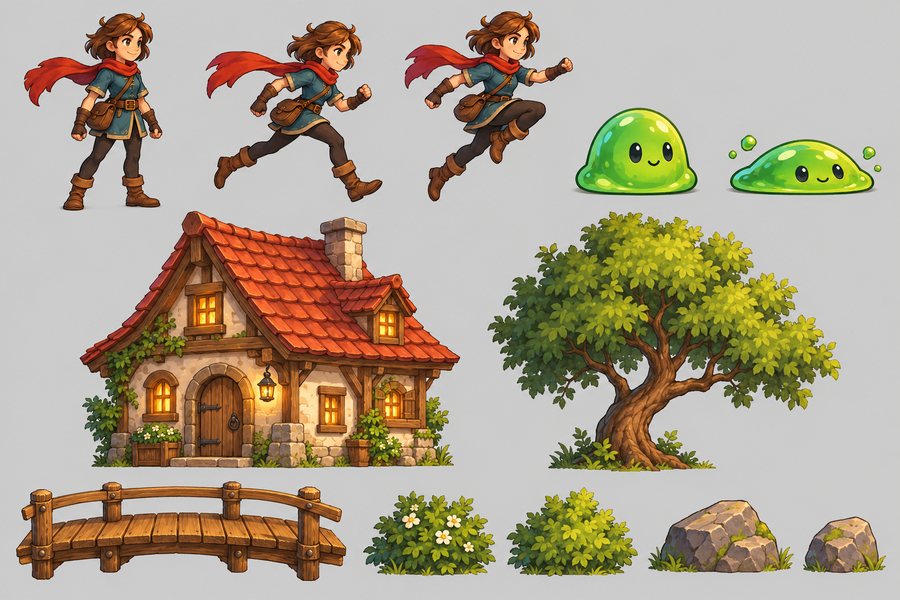 pictures from AI
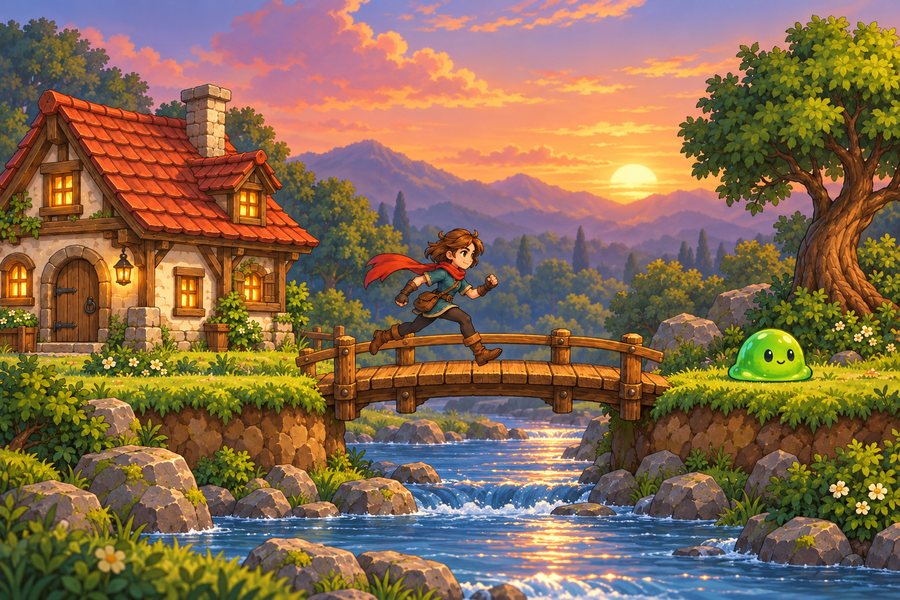 finished 2D scene
- what you get
- A hand-drawn 2D world: hero, enemies, backgrounds and UI in one style. The hero is animated like a puppet or from video.
- how it works
- AI paints; code animates and lights. To keep the hero consistent, each request repeats the same style phrases (an anchor) and samples.
- what you need
- One of three ways: ChatGPT Plus, the API paid per picture, or your own computer with an NVIDIA card with 12 GB or more. With Plus, you carry its requests to ChatGPT by hand. With Plus, Codex draws by itself.
- cost
- ChatGPT Plus: $20 a month, on top of Claude Pro: already have it? No extra cost, but limits go faster. The API has no monthly fee: first top-up from $10; we estimate $1–3 for all the game's pictures, and optional hero clips add $1–4.5. On your own computer there's no extra cost, but you wait longer.
- who it's for
- You want a hand-drawn look: painting, watercolor, detailed characters.
The best approach is to combine them. For example, build the world as a model, let AI paint the hero, and make the animation clips on your own computer.
The lessons follow one main route so the steps don’t get mixed up, but in your own game you can combine them. You can still change the main route before the project step on day 5.
What we will make in this genre
By the finale: 6 levels of 30–60 s plus an ending screen, about 5 minutes.
In “Model to match”: the hero moves on a plane, the camera looks from the side, and the scenery has depth.
Start with one ability you enjoy using. We will build levels around it.
By the finale: a 5-minute run: 4 waves and a boss at minute five, 6–8 upgrades to choose from.
In “Model to match”: an angled overhead camera shows the field and a hundred enemies as a 3D diorama.
Think about what the player chooses between waves and how that affects the next fight.
By the finale: 8 levels: the first 3 teach, the twist starts at level five.
In “Model to match”: the board looks like a tabletop puzzle, viewed from a distance.
Start with one rule and find different problems you can build from it.
By the finale: 3 fights and a boss; 8 cards at the start, 15–18 in total.
In “Model to match”: cards sit on a table, with pictures made from screenshots of game models.
The player should understand what a card does before playing it.
By the finale: one map, 3 waves, a win at minute five.
In “Model to match”: an angled overhead camera looks across a 3D map.
Start with one resource, two buildings and three units. Check that giving orders feels comfortable.
By the finale: 5 in-game days, the goal is saving up for a big purchase.
In “Model to match”: your garden, kitchen or shop looks like a tabletop diorama with warm light.
Give the player a goal without a way to lose, such as saving for a purchase.
By the finale: 8–12 scenes, 3 choices with consequences, 2 endings.
In “Model to match”: a live 3D diorama sits behind the text, like an animated book illustration.
Choose the player's role and the decision they will make most often.
By the finale: 3 rooms and an exit.
In “Model to match”: a 3D world viewed from above or through the hero's eyes. “AI paints it” gives you a hand-drawn top-down game.
Start with one arena and one weapon that feels good to fire.
By the finale: a village, a 3-room dungeon and a boss; one main quest and one side quest; 3 hero levels.
In “Model to match”: the village is a 3D diorama viewed from an overhead angle.
Make the hero's growth noticeable to the player.
Your chosen genre is already included in the interview prompt.
What one sentence leaves for the agent to decide
You can tell the agent “make Vampire Survivors underwater” and it will build something. But it will have to pick the hero, the action, the obstacles and the length on its own. Better to decide those together.
Below are three such lines from different genres. Press “Hand it to the agent”, then swap in your own calls on the cards. It's just practice: you'll take apart your own idea the same way in the interview.
One line is a fine start if you spin it out yourself. Arvi Teikari made Baba Is You at a jam themed “Not there”. That made him think of logical NOT and gave him “a mental image of pushing words to create rules” (Game Developer, 2018).
You asked for “a lighthouse game” and got a finished draft. Who chose the number of levels?
- The agent; I did not specify itYes. It had to fill in the parts missing from your request.
- I did, because it was my ideaThe idea is yours, but the level count is a separate decision you had not made.
- Nobody has chosen that yetThe finished draft already has some number of levels. The agent chose it.
Create a folder for your game
Keep your remix in first-game. Create ~/games/my-game for the new game and open the agent there, so the files stay separate.
Leave the old chat with /exit, then paste the command for your system into the terminal:
Leave the old chat with /exit, then paste the command for your system into the terminal:
- New sessionStart in the Code tab, environment Local.
- New folderFolder picker → Open folder… Inside
games, createmy-gameand pick it. - ModeAuto, or Accept edits if there's no Auto.
- New folderChoose Open folder (on a Mac, Cmd + O). Inside
games, createmy-gameand pick it. - Where to workIn the Work in switch keep This computer, mode Ask for approval.
If the agent asks whether you trust the folder, check that it is my-game and confirm. Then create the notes file. If you did this on day 2, the prompt will look familiar; it adds one line for the new game.
Check that the agent has opened ~/games/my-game and created notes in that folder.
How to check:
- Asked “Which folder are you in?”, the agent names a path ending in
my-game - The agent showed the notes, with the line “This is my game's folder”
If the agent says first-game, close it and restart in the new folder using the instructions above.
Talk through the idea
Have the agent ask questions with answer options while you choose what the game will be. The prompt already includes your genre and art method. Replace “[my idea]” with yours, such as “a rookie cook keeps a night noodle bar going until closing”. Any topic and genre will do; you don't need to repeat the lesson's examples. If you have no idea yet, ask for three suggestions.
Questions may appear as buttons or text. A short text reply is enough: “1A, 2B, 3 — my own: the broth boils over if you look away”. If you are unsure, take the recommendation and revisit it later.
The player's role decides a lot. Lucas Pope on Papers, Please: you're not the hero slipping across the border but the guard checking documents (Game Developer, 2014). New role, new game.
After the questions, the agent records the decisions in GAME.md. Here's a sample for someone else's idea; yours will have its own hero and world:
Check all eight decisions. Most should be choices you made.
How to check:
GAME.mdis in the folder and fits on one screen- Eight decisions, each marked “my call” or “agent's call”
- No more than three “agent's call”
If the agent starts coding, stop it: “Questions first, code later.” If it asks about engines or other software, say, “Choose the technology yourself; ask me about the game.”
Choose a game you can finish
Now check the size of the game. We are aiming for about 5 minutes on a first playthrough and 10 evenings of work. Add features to the backpack and watch both meters. Keep them in the green without overfilling it.
When you like the selection, press “copy” beneath the backpack and send the task to the agent.
The Chrome dino lost its roar and kick, keeping “the basics of any good runner game: run, duck and jump” (Google blog, 2018). Spelunky's Derek Yu: ship one sloppy, fun little game fast, then a slightly bigger one (GameMaker, 2024).
Choose a scope you can finish by day 15.
How to check:
- Backpack: 4–6 minutes of play, at most 10 evenings
- “Scope” in
GAME.mdis all numbers - Open world, online play and such: in “Not in the game”
If extra features remain, ask: “Remove everything from Scope that is not on my list.”
Write two rules you can check
Put two rules in GAME.md to help judge later changes. For each, describe the experience you want and a sign that it has broken down. When you are unsure about an addition, come back to those rules and see whether it fits.
“The game is fun and pretty”
“The player feels every pit is doable first try without rushing; broken if they fall three times running”
Sort the cards: which statements can you check in the game, and which are still wishes?
Read both rules in GAME.md. Each needs a “broken if” condition. Then reply to the agent:
Build your first draft
The agent now has enough to make a first draft: one screen of shapes, a main action, an obstacle, a win and a loss. First, see whether you enjoy jumping, shooting or planting, whichever matters in your game. We will work on pictures later.
The “Model to match” draft is flat for now too. We will add depth next lesson.
The agent opens the draft itself. Click the path to sketch.html in the chat, and the draft opens in the Browser panel. Open the draft in the built-in browser or by double-clicking the file. If the draft doesn't open by itself, double-click sketch.html. Play three rounds.
Optional: reuse your practice settings
Use this only if you want to keep the old jump or flight settings. For a different mechanic, start with new settings.
Mini Metro began the same way: a weekend prototype at Ludum Dare 26, rule “Nothing art-heavy” (postmortem, 2016). The first Super Mario Bros. prototype was a square moving around (Iwata Asks).
Open the draft and try the action you built the idea around.
How to check:
- The main action works on first press
- A round ends in a win or loss
- After round three you want a fourth. If not, note why for tomorrow
If it is too hard, ask to make the first 20 seconds twice as easy. If the agent built the wrong action, say, “The main action is [action]. Change only that.”
Check and save the first version
The draft runs. Compare it with your idea before saving.
The agent checks
★ Fresh eyes
Start a new chat: type /cleartype /newopen a new session in the same folder. Have the agent check the files without the interview conversation.
Compare the result with the one-line description in GAME.md.
You play
Play three rounds. Can you recognize the game you wanted to make?
Now ask to save the result. The agent will set up version history in the new folder:
GAME.md says, “The game should be fun.” How could you make this more useful?
- Add a condition you can checkYes. Describe what should happen in a particular section and what result would reveal a problem.
- Leave it as it is; it is the main ruleIt is a useful wish, but it does not yet say what to check.
- Change it to “very fun”That adds emphasis, but still no test. You need a specific condition.
The backpack cannot fit both an open world and online play. What should happen to those ideas?
- Keep them; the agent will manageEven with an agent, a large project will not fit into ten evenings.
- Remove the levels to make roomStart by removing the large extras your intended playthrough does not need.
- Move both to “Not in the game”Right. That makes the limit clear to both you and the agent.
Why build the first draft from shapes?
- The agent cannot work with picturesIt can, but we are leaving the look until days 7–8. Today we are checking the action.
- To test the main action before working on artYes. First, find out whether you want to play it.
- Only to make it load fasterThe main purpose is to check the action and rules while the draft is small.
You do not yet know how long the game should be. How can you continue?
- Take the recommendation and record itYes. You can start there and revise it later.
- Put the whole interview off until tomorrowIf you want to keep going, try the suggested option. You are still allowed to change your mind.
- Skip the answer and let the agent decide silentlyIt is better to see and record the choice, so you know what was decided.
What can the Chrome dino example suggest for your first game?
- Good games have lots of actionsThree are enough for the dino, and millions play it.
- The dino is just a filler gameIt's a real little game. And it runs on three actions.
- Choose a few actions and tune them wellYes. A smaller set leaves more time to work on each action.
Until which step can you switch art methods without moving the project over?
- Only today, while on day 4You have some slack: until the project step on day 5.
- Until day 5's project stepYes. That's where the game starts being built for your route.
- Any time, it doesn't matterIt does: from day 5 the game is built for your route, and switching is extra work.
Ask someone else to explain the game
- Give the draft to someone who has not seen it. Watch how they start playing
- Then ask them to describe the game in one sentence
- Compare that with the one-line description in GAME.md. If it is inaccurate, update it: “Change the one-line description in GAME.md to: …”
- A bolder second draft: play both, keep the closer one
Play a reference game for 10 minutes. Write down one specific design choice you want to try.
Celeste or Super Mario Bros.: how the first screen teaches jumping without words.
Vampire Survivors or Brotato: what the player is offered between waves.
Baba Is You or 2048: how the first level explains the rule.
Slay the Spire or Balatro: what the starting deck is made of and when a new card arrives.
Warcraft III or Age of Empires: what the player does in the first minute.
Stardew Valley or Cookie Clicker: what the player does on the first in-game day.
Reigns or Papers, Please: which choice comes up most often.
DOOM or Half-Life: how the first room teaches you to move and shoot.
Pokémon or Undertale: how the very first fight works.
| criteria | pass |
|---|---|
| Draft | main action, win and loss work |
| GAME.md | 8 decisions, at most three “agent's call” |
| One line | the player retold it almost in your words |
| Day's version | saved with the tag day-04 |
Time: about 20 minutes.
- Discuss the decisions with the agent. If you give it only one sentence, it will have to choose the rest.
- Keep GAME.md to one screen. Eight decisions, with no more than three left to the agent.
- A rule needs a check. Describe the intended player experience and a “broken if” condition.
- Plan for about 5 minutes of play and 10 evenings of work. Put the other ideas in “Not in the game”.
- Test the action with shapes first. Add pictures later.
Sources
- Road to the IGF: Hempuli Oy's Baba Is You
- Road to the IGF: Lucas Pope's Papers, Please
- As the Chrome dino runs, we caught up with the Googlers who built it
- Derek Yu: an interview for GameMaker's 25th anniversary
- Postmortem: Dinosaur Polo Club's Mini Metro
- Iwata Asks: Super Mario Bros. 25th Anniversary, Vol. 5
- Guilty Gear Xrd Art Talk at Game Developers Conference 2015
- Codex: Pricing, ChatGPT: Pricing, Sora
- ComfyUI: MiniMax H3, ComfyUI: Qwen-Image-Edit-2511
- OpenRouter: Pricing; model prices for FLUX 3 Image Klein, Nano Banana 2.1, GPT Image 2, Seedance 2.0 Mini
You have finished the first world and have a game of your own, still made from shapes. Next lesson, we will move it into a project, make it fit the window and teach the agent to check screenshots.